

-
1 current conductor
-
2 current conductor
n ELECTRON Stromleiter m -
3 current-carrying conductor
current-carrying conductor Strom führender Leiter mEnglish-German dictionary of Electrical Engineering and Electronics > current-carrying conductor
-
4 current-carrying conductor
<el> ■ stromdurchflossener Leiter mEnglish-german technical dictionary > current-carrying conductor
-
5 neutral conductor current
neutral conductor current Mittelleiterstrom mEnglish-German dictionary of Electrical Engineering and Electronics > neutral conductor current
-
6 neutral conductor
<el> ■ Mp-Leiter m ; neutraler Leiter m ; Nullleiter m ; Sternpunktleiter m<el> (of three-phase current) ■ Neutralleiter m (N); Sternpunktleiter m form ; Mittelpunktleiter m ; Mittelleiter m ; N-Leiter m prakt -
7 phase current
-
8 nominal conductor current
<el> ■ Leiternennstrom mEnglish-german technical dictionary > nominal conductor current
-
9 длительный допустимый ток
- Strombelastbarkeit, f
- Dauerstrombelastbarkeit, f
(длительный) допустимый ток
Максимальное значение электрического тока, который может протекать длительно по проводнику, устройству или аппарату при определенных условиях без превышения определенного значения их температуры в установившемся режиме
[ ГОСТ Р МЭК 60050-826-2009]
Этот ток обозначают IZ
[ ГОСТ Р 50571. 1-2009 ( МЭК 60364-1: 2005)]EN
(continuous) current-carrying capacity
ampacity (US)
maximum value of electric current which can be carried continuously by a conductor, a device or an apparatus, under specified conditions without its steady-state temperature exceeding a specified value
[IEV number 826-11-13]
ampacity
The current in amperes that a conductor can carry continuously under the conditions of use without exceeding its temperature rating.
[National Electrical Cod]FR
courant (permanent) admissible, m
valeur maximale du courant électrique qui peut parcourir en permanence, un conducteur, un dispositif ou un appareil, sans que sa température de régime permanent, dans des conditions données, soit supérieure à la valeur spécifiée
[IEV number 826-11-13]Ampacity, the term is defined as the maximum amount of current a cable can carry before sustaining immediate or progressive deterioration. Also described as current rating or current-carrying capacity, is the RMS electric current which a device can continuously carry while remaining within its temperature rating. The ampacity of a cable depends on:
- its insulation temperature rating;
- conductor electrical properties for current;
- frequency, in the case of alternating currents;
- ability to dissipate heat, which depends on cable geometry and its surroundings;
- ambient temperature.
Electric wires have some resistance, and electric current flowing through them causes voltage drop and power dissipation, which heats the cable. Copper or aluminum can conduct a large amount of current before melting, but long before the conductors melt, their insulation would be damaged by the heat.
The ampacity for a power cable is thus based on physical and electrical properties of the material & construction of the conductor and of its insulation, ambient temperature, and environmental conditions adjacent to the cable. Having a large overall surface area may dissipate heat well if the environment can absorb the heat.
In a long run of cable, different conditions govern, and installation regulations normally specify that the most severe condition along the run governs the cable's rating. Cables run in wet or oily locations may carry a lower temperature rating than in a dry installation. Derating is necessary for multiple circuits in close proximity. When multiple cables are near, each contributes heat to the others and diminishes the amount of cooling air that can flow past the individual cables. The overall ampacity of the insulated conductors in a bundle of more than 3 must be derated, whether in a raceway or cable. Usually the de-rating factor is tabulated in a nation's wiring regulations.
Depending on the type of insulating material, common maximum allowable temperatures at the surface of the conductor are 60, 75 and 90 degrees Celsius, often with an ambient air temperature of 30°C. In the U.S., 105°C is allowed with ambient of 40°C, for larger power cables, especially those operating at more than 2 kV. Likewise, specific insulations are rated 150, 200 or 250°C.
The allowed current in cables generally needs to be decreased (derated) when the cable is covered with fireproofing material.
For example, the United States National Electric Code, Table 310-16, specifies that up to three 8 AWG copper wires having a common insulating material (THWN) in a raceway, cable, or direct burial has an ampacity of 50 A when the ambient air is 30°C, the conductor surface temperature allowed to be 75°C. A single insulated conductor in air has 70 A rating.
Ampacity rating is normally for continuous current, and short periods of overcurrent occur without harm in most cabling systems. The acceptable magnitude and duration of overcurrent is a more complex topic than ampacity.
When designing an electrical system, one will normally need to know the current rating for the following:- Wires
- Printed Circuit Board traces, where included
- Fuses
- Circuit breakers
- All or nearly all components used
Some devices are limited by power rating, and when this power rating occurs below their current limit, it is not necessary to know the current limit to design a system. A common example of this is lightbulb holders.
[http://en.wikipedia.org/wiki/Ampacity]
Тематики
- электротехника, основные понятия
Синонимы
EN
DE
- Dauerstrombelastbarkeit, f
- Strombelastbarkeit, f
FR
- courant admissible, m
- courant permanent admissible, m
Русско-немецкий словарь нормативно-технической терминологии > длительный допустимый ток
-
10 ток защитного проводника
- Schutzleiterstrom, m
ток защитного проводника
Электрический ток, возникающий в защитном проводнике, такой как, например, ток утечки, или электрический ток, возникающий в результате повреждения изоляции
[ ГОСТ Р МЭК 60050-826-2009]
ток защитного проводника
Ток, проходящий через защитный проводник.
Примечание - Этот ток может повлиять на работу устройств защиты от остаточного тока, присоединенных к той же цепи.
[ ГОСТ Р МЭК 60598-1-2011]EN
protective conductor current
electric current appearing in a protective conductor, such as leakage current or electric current resulting from an insulation fault
[IEV number 826-11-21]FR
courant dans le conducteur de protection, m
courant électrique apparaissant dans un conducteur de protection, tel que courant de fuite ou courant électrique du à un défaut d’isolation
[IEV number 826-11-21]Тематики
EN
DE
- Schutzleiterstrom, m
FR
- courant dans le conducteur de protection, m
Русско-немецкий словарь нормативно-технической терминологии > ток защитного проводника
-
11 ток короткого замыкания
ток короткого замыкания
Сверхток, появляющийся в результате короткого замыкания, вызываемого повреждением или неправильным соединением в электрической цепи.
МЭК 60050(441-11-07)
[ ГОСТ Р 50030. 1-2000 ( МЭК 60947-1-99)]
ток короткого замыкания
Сверхток, обусловленный замыканием с ничтожно малым полным сопротивлением между точками, которые в нормальных условиях эксплуатации должны иметь различный потенциал.
Примечание — Ток короткого замыкания может явиться результатом повреждения или неправильного соединения
(МЭС 441—11—07)
[ ГОСТ Р 50345-99( МЭК 60898-95)]
ток короткого замыкания
Электрический ток в данной короткозамкнутой цепи.
[ ГОСТ Р МЭК 60050-195-2005]
ток короткого замыкания (Ic)
Сверхток, появляющийся в результате короткого замыкания, вследствие повреждения или неправильного соединения в электрической цепи
[ ГОСТ Р 51321. 1-2000 ( МЭК 60439-1-92)]
ток короткого замыкания
Электрический ток при данном коротком замыкании.
[ ГОСТ Р МЭК 60050-826-2009]
ток короткого замыкания
Сверхток, возникающий в результате короткого замыкания из-за дефекта или неправильного подключения в электрической цепи.
[ ГОСТ Р МЭК 60204-1-2007]EN
short-circuit current
an over-current resulting from a short circuit due to a fault or an incorrect connection in an electric circuit
[IEV number 441-11-07]
short-circuit current
electric current in a given short-circuit
Source: 603-02-28 MOD
[IEV number 195-05-18]
[IEV number 826-11-16]FR
courant de court-circuit
surintensité résultant d'un court-circuit dû un défaut ou à un branchement incorrect dans un circuit électrique
[IEV number 441-11-07
courant de court-circuit
courant électrique dans un court-circuit déterminé
Source: 603-02-28 MOD
[IEV number 195-05-18]
[IEV number 826-11-16]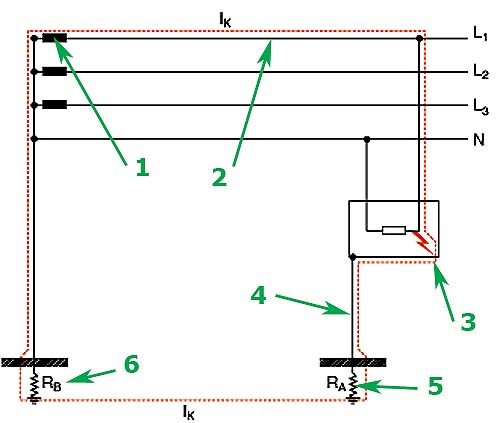
Рис. 7 (Рис. ABB)
Контур тока короткого замыкания при замыкании на землю в системе ТТ
1 - Вторичная обмотка трансформатора;
2 - Линейный проводник;
3 - Сопротивление в месте замыкания;
4 - Проводник защитного заземления;
5 - Зазеамляющий электрод электроустановки;
6 - Заземляющий электрод нейтрали вторичной обмотки тарнсформатораПараллельные тексты EN-RU
An earth fault in a TT system originates the circuit represented in Figure 7.
The fault current flows through the secondary winding of the transformer, the line conductor, the fault resistance, the protective conductor, and the earth electrode resistances (RA, of the user’s plant, and RB, of the neutral).
[ABB]Замыкание на землю в системе TT образует цепь, представленную на рисунке 7.
Ток короткого замыкания протекает через вторичную обмотку трансформатора, линейный проводник, сопротивление в месте замыкания, проводник защитного заземления, заземляющие электроды (RA электроустановки и RB нейтрали вторичной обмотки трансформатора).
[Перевод Интент]Тематики
- электробезопасность
- электротехника, основные понятия
- электроустановки
EN
DE
FR
Русско-немецкий словарь нормативно-технической терминологии > ток короткого замыкания
-
12 местный ток при нарушении непрерывности цепи
местный ток при нарушении непрерывности цепи
Электрический ток в данной точке электрической сети, вызванный нарушением непрерывности проводника в другой точке этой сети.
[ ГОСТ Р МЭК 60050-195-2005]EN
partial (conductor) continuity fault current
electric current at a given point of a network and resulting from a conductor continuity fault at another point of the same network
Source: 603-02-25 MOD
[IEV number 195-05-19]FR
courant partiel de défaut série
courant électrique en un point d'un réseau, dû à un défaut série en un autre point de ce réseau
Source: 603-02-25 MOD
[IEV number 195-05-19]EN
DE
FR
Русско-немецкий словарь нормативно-технической терминологии > местный ток при нарушении непрерывности цепи
-
13 ток при нарушении непрерывности цепи
ток при нарушении непрерывности цепи
Электрический ток, определяемый полным сопротивлением поврежденной цепи.
[ ГОСТ Р МЭК 60050-195-2005]EN
(conductor) continuity fault current
electric current in the impedance causing the conductor continuity fault
Source: 603-02-27 MOD
[IEV number 195-05-20]FR
courant de défaut série
courant électrique dans l'impédance causant le défaut série
Source: 603-02-27 MOD
[IEV number 195-05-20]EN
DE
FR
Русско-немецкий словарь нормативно-технической терминологии > ток при нарушении непрерывности цепи
-
14 опорный трансформатор тока
опорный трансформатор тока
Трансформатор тока, предназначенный для установки на опорной плоскости.
[ ГОСТ 18685-73]EN
support type current transformer
a current transformer so arranged that it acts as a support for the conductor in the primary circuit
[IEV number 321-02-08]FR
transformateur de courant type support de conducteur primaire
transformateur de courant agencé de telle sorte qu'il joue le rôle de support pour le conducteur servant de circuit primaire
[IEV number 321-02-08]A current transformer so arranged that it acts as a support for the conductor in the primary circuit.
Трансформатор тока является опорой для проводника первичной обмотки.
[Интент]Тематики
Классификация
>>>EN
DE
FR
Русско-немецкий словарь нормативно-технической терминологии > опорный трансформатор тока
-
15 разъемный трансформатор тока
разъемный трансформатор тока
Трансформатор тока без первичной обмотки, магнитная цепь которого может размыкаться и затем замыкаться вокруг проводника с измеряемым током.
[ ГОСТ 18685-73]EN
split core type current transformer
a current transformer without primary conductor, and primary insulation of its own, the magnetic circuit of which can be hinged open (or otherwise separated into two parts) and then closed around the insulated conductor carrying the current to be measured
[IEV number 321-02-05]FR
transformateur de courant à circuit magnétique ouvrant
transformateur de courant sans enroulement primaire et sans isolation propre dont le circuit magnétique peut être ouvert puis refermé autour d'un conducteur isolé parcouru par le courant à mesurer
[IEV number 321-02-05]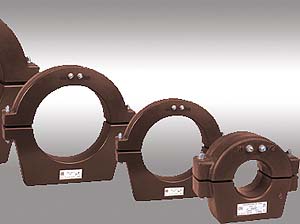
[http://www.rusotools.ru/offers/8774/разъемный-трансформатор-тока-тзрл-125-у3.html]
Трансформатор выполнен в виде опорной разъемной конструкции. Роль первичной обмотки выполняет трехфазный кабель на напряжение до 10 кВ, пропущенный в окно трансформатора. Вторичная обмотка намотана на тороидальный магнитопровод, разрезанный пополам. Обе части, залитые изоляционным компаундом на основе эпоксидной смолы, соединяются болтами. Опорой трансформатора служит основание изоляционного корпуса со специальными втулками для крепления[http://www.laborant.ru/eltech/02/4/1/27-99.htm]
Недопустимые, нерекомендуемые
- разборный трансформатор
- расчленяемый трансформатор тока
- трансформатор тока с раздельным сердечником
- трансформатор тока с расчленяемым сердечником
Тематики
Классификация
>>>Синонимы
EN
DE
FR
Русско-немецкий словарь нормативно-технической терминологии > разъемный трансформатор тока
-
16 жила
- stromführende Ader
- Leiter (eines Kabels), m
- Einzeldraht
токопроводящая жила
жила
Элемент кабельного изделия, предназначенный для прохождения электрического тока
[ ГОСТ 15845-80]
токопроводящая жила (кабеля)
Элемент кабеля, специфической функцией которого является передача электрического тока
[IEV number 461-01-01]
жила токопроводящая
Изолированный одно- или многопроволочный металлический проводник внутри электрического кабеля
[Терминологический словарь по строительству на 12 языках (ВНИИИС Госстроя СССР)]
жила
-
[IEV number 151-12-37]EN
conductor (of a cable)
part of a cable which has the specific function of carrying current
[IEV number 461-01-01]
strand
one of the wires of a stranded conductor
Source: 466-10-02 MOD
[IEV number 151-12-37]FR
âme
conducteur (d'un câble) (terme déconseillé dans ce sens)
partie d'un câble dont la fonction spécifique est de conduire le courant
[IEV number 461-01-01]
brin, m
un des fils d'un conducteur câblé
Source: 466-10-02 MOD
[IEV number 151-12-37]Все жилы двухжильных кабелей должны быть одинакового сечения.
Все жилы трех- и четырехжильных кабелей должны быть одинакового сечения или одна жила должна быть меньшего сечения (нулевая или жила заземления)
Номинальное сечение, мм2
основная жила: 25
нулевая жила: 16
жила заземления: 10
Изолированные жилы многожильных кабелей должны иметь отличительную расцветку или обозначение цифрами, начиная с нуля.
[ ГОСТ 433-73]
Токопроводящие жилы должны быть изолированы поливинилхлоридным пластикатом.
Изолированные жилы должны быть скручены в кабель.
[ ГОСТ 10348-80]Недопустимые, нерекомендуемые
Тематики
- кабели, провода...
Действия
Синонимы
Сопутствующие термины
EN
- cable
- cable conductors
- conductor
- conductor core
- conductor of a cable
- conductors
- core
- electric conductor
- strand
DE
- Einzeldraht
- Leiter (eines Kabels), m
- stromführende Ader
FR
Русско-немецкий словарь нормативно-технической терминологии > жила
-
17 проводящий
проводящий (1)
-
[IEV number 151-15-56]
проводящий (2)
кондукционный
-
[IEV number 151-15-57]EN
conductive, adj
qualifies a medium to indicate that it can carry electric current
NOTE 1 – In French, the term "conducteur" is also used as a noun to designate a conductor or conductive medium.
NOTE 2 – In French, the term "conducteur" is also used as a noun corresponding to the English "conductor".
Source: see IEC 60050-121, 151-12-05
[IEV number 151-15-56]
conducting, adj
qualifies a device or an electric circuit to indicate that it is carrying electric current
[IEV number 151-15-57]FR
conducteur (1), adj
qualifie un milieu qui peut être parcouru par un courant électrique
NOTE 1 – En français, le terme "conducteur" est aussi employé comme nom pour désigner un milieu conducteur.
NOTE 2 – En français, le terme "conducteur" est aussi employé comme nom correspondant à l'anglais "conductor".
Source: voir la CEI 60050-121, 151-12-05
[IEV number 151-15-56]
passant, adj
conducteur (2), adj
qualifie un dispositif ou un circuit électrique parcouru par un courant électrique
[IEV number 151-15-57]EN
- conducting, adj
- conductive, adj
DE
FR
- conducteur (1), adj
- passant, adj
Русско-немецкий словарь нормативно-технической терминологии > проводящий
-
18 проводник
проводник (1)
Вещество, основным электрическим свойством которого является электропроводность.
[ ГОСТ Р 52002-2003]
проводник (2)
Всё то, что используется (предназначается) для проведения электрического тока:
- провод;
- кабель;
- шина;
- шинопровод;
- жила провода (кабеля);
- проводник печатной платы.
[Интент]
проводник (2)
Проводящая часть, предназначенная для проведения электрического тока определенного значения.
[ ГОСТ Р МЭК 60050-195-2005]
проводник (2)
Проводящая часть, предназначенная для проведения электрического тока определённого значения.
Проводники представляют собой проводящие части, которые предназначены для проведения электрического тока в электрических цепях электрооборудования и электроустановки здания. Помимо качественной характеристики проводника, указывающей на его способность проводить электрический ток, каждый проводник имеет количественную характеристику, называемую допустимым длительным током. Протекание по проводнику сверхтока вызывает перегрев проводника, который может быть причиной пожара. Поэтому проводники в электроустановках зданий защищают от сверхтоков.
К проводникам, прежде всего, относят жилы проводов и кабелей, из которых выполнены стационарные электропроводки в электроустановке здания, жилы гибких проводов и кабелей, используемых для подключения переносного и передвижного электрооборудования к стационарным электропроводкам, различные шины, применяемые в низковольтных распределительных устройствах и в шинопроводах, а также другие проводящие части, выполняющие функции проводников.
В электроустановках зданий применяют проводники различного назначения. Для обеспечения электрооборудования электрической энергией в электрических цепях переменного тока используют фазные проводники, нейтральные проводники и PEN-проводники, а в электрических цепях постоянного тока – полюсные проводники, средние проводники и PEM-проводники. Защитные проводники, а также PEN-проводники, PEM-проводники и PEL-проводники применяют в электроустановках зданий для защиты от поражения электрическим током.
[ http://www.volt-m.ru/glossary/letter/%CF/view/49/]EN
conductor
element intended to carry electric current
NOTE 1 – The term "conductor" is often used for an element the length of which is large with respect to the cross-sectional dimensions, e.g. conductors of a line or of a cable.
NOTE 2 – The English term "conductor" and the French term "conducteur" have also the meaning of "conducting medium".
NOTE 3 – In French, the term "conducteur" is also used as an adjective corresponding to the English "conductive".
[IEV number 151-12-05]FR
conducteur, m
élément destiné à assurer le passage d'un courant électrique
NOTE 1 – Le terme "conducteur" est souvent utilisé pour un élément dont la longueur est grande par rapport aux dimensions de la section droite, par exemple les conducteurs d'une ligne ou d'un câble.
NOTE 2 – Le terme français "conducteur" et le terme anglais " conductor " ont aussi le sens de "milieu conducteur".
NOTE 3 – En français, le terme "conducteur" est aussi employé comme adjectif correspondant à l'anglais "conductive".
[IEV number 151-12-05]К зажиму допускается присоединение двух медных проводников сечением от 1,0 до 4,0 мм2.
Тематики
- электротехника, основные понятия
Действия
- обесточивать проводник
- определять сечение проводника
- отключать проводник
- отсоединять проводник
- присоединять проводник
- присоединять проводник накруткой
- проводник должен пропускать ток
- соединять проводники
EN
DE
FR
Русско-немецкий словарь нормативно-технической терминологии > проводник
-
19 ожидаемый ток
ожидаемый ток
Ток, который будет в цепи, если коммутационный аппарат зашунтироватъ проводником с пренебрежимо малым сопротивлением.
[ ГОСТ 17703-72]EN
prospective current
the current that would flow in the circuit, if each main current path of the switching device and of the overcurrent protective device, if any, were replaced by a conductor of negligible impedance
NOTE – The prospective current can be qualified in the same manner as an actual current, for example: prospective breaking current, prospective peak current, prospective residual current, etc.
[IEV number 442-01-47]FR
courant présumé
courant qui circulerait dans le circuit, si chaque voie principale de courant du dispositif de coupure et du dispositif éventuel de protection contre les surintensités était remplacée par un conducteur d'impédance négligeable
NOTE – Le courant présumé peut être qualifié de la même façon qu'un courant réel, par exemple courant de coupure présumé, courant de crête présumé, courant différentiel présumé, etc.
[IEV number 442-01-47]Тематики
- аппарат, изделие, устройство...
EN
DE
FR
Русско-немецкий словарь нормативно-технической терминологии > ожидаемый ток
-
20 экранирующий провод
экранирующий провод
отдельный провод или одножильный кабель, проложенный параллельно кабелю или кабельному каналу, являющийся частью замкнутой цепи, по которой могут проходить наведенные токи, магнитное поле которых будет противоположно полю в кабеле (ях)
[IEV number 461-12-01]EN
shielding conductor
separate conductor or single-core cable laid parallel to a cable or cable circuit and itself forming part of a closed circuit in which induced currents may flow whose magnetic field will oppose the field caused by the current in the cable(s)
[IEV number 461-12-01]FR
conducteur écran
conducteur de protection (déconseillé dans ce sens)
conducteur séparé ou câble à un conducteur posé parallèlement le long d'un câble ou d'un circuit de câbles et faisant lui-même partie d'un circuit fermé dans lequel peuvent circuler des courants induits dont le champ magnétique s'oppose à celui produit par les courants circulant dans le ou les câbles
[IEV number 461-12-01]Тематики
- кабели, провода...
EN
DE
FR
Русско-немецкий словарь нормативно-технической терминологии > экранирующий провод
- 1
- 2
См. также в других словарях:
current conductor — Смотри Токопровод … Энциклопедический словарь по металлургии
Conductor — or conduction may refer to: In science: Electrical conductor, a material allowing the flow of electric current Electrical conduction, the movement of charged particles through an electrical conductor Fast ion conductor, a solid state electrical… … Wikipedia
Conductor marking lights — are a particular type of non standard aircraft warning lights designed for overhead power lines. Conductor marking lights Contents 1 Background … Wikipedia
Current crowding — (also current crowding effect, or CCE) is a nonhomogenous distribution of current density through a conductor or semiconductor, especially at the vicinity of the contacts and over the PN junctions. Current crowding is one of the limiting factors… … Wikipedia
current — [kʉr′ənt] adj. [altered (infl. by L) < ME curraunt < OFr curant, prp. of courre < L currere, to run < IE base * kers , to run, wagon > Gaul carros] 1. Obs. running or flowing 2. a) now going on; now in progress [the current month,… … English World dictionary
current density — n. the amount of electric current passing through a cross sectional area (perpendicular to the direction of current) of a conductor in a given unit of time: commonly expressed in amperes per square centimeter or amperes per square inch … English World dictionary
Current clamp — For current clamp recording in neurons, see Electrophysiology#Current clamp. In electrical and electronic engineering, a current clamp or current probe is an electrical device having two jaws which open to allow clamping around an electrical… … Wikipedia
Current transformer — A CT for operation on a 110 kV grid In electrical engineering, a current transformer (CT) is used for measurement of electric currents. Current transformers, together with voltage transformers (VT) (potential transformers (PT)), are known as … Wikipedia
Current density — This page is about the electric current density in electromagnetism. For the probability current density in quantum mechanics, see Probability current. Current density is a measure of the density of flow of a conserved charge. Usually the charge… … Wikipedia
conductor — conductorial /kon duk tawr ee euhl, tohr /, adj. conductorship, n. /keuhn duk teuhr/, n. 1. a person who conducts; a leader, guide, director, or manager. 2. an employee on a bus, train, or other public conveyance, who is in charge of the… … Universalium
Conductor pipe — The Conductor Pipe[1] is a large diameter pile that is set into the ground to provide the initial stable structural foundation for a borehole or oil well. It can also be referred to as a drive pipe because it is often driven into the ground with… … Wikipedia
